You finish a hard workout feeling great.
Then the next morning arrives.
Your legs feel heavy. Your shoulders are tight. Going down the stairs suddenly feels like a workout of its own.
Whether you lift weights, run, play pickleball, golf, cycle, train on weekends or simply stay active, soreness can make it harder to get back to the activities you enjoy.
That is one reason cryotherapy for recovery has become increasingly popular among active adults looking for a quick, non-invasive addition to their wellness routine.
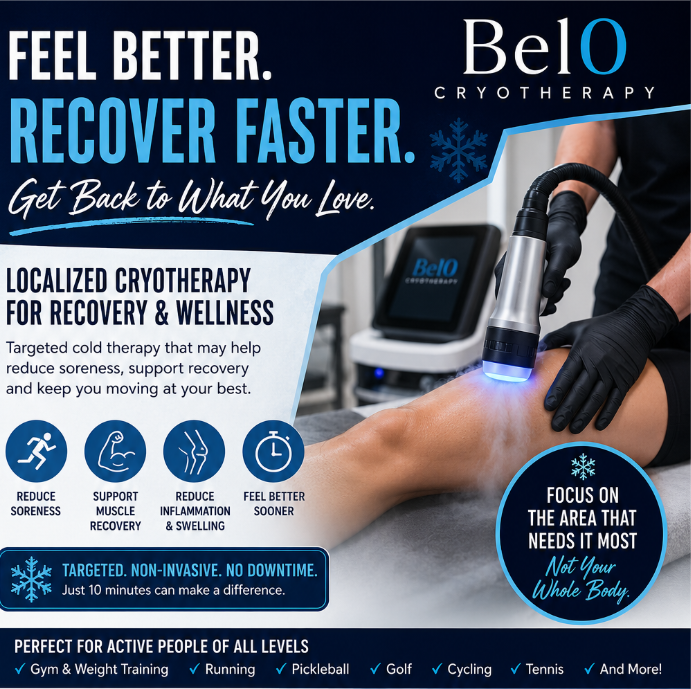
At Bel0 Cryotherapy in East Hanover, NJ, localized cryotherapy allows cold to be directed toward a specific area instead of exposing the entire body to a cryotherapy chamber.
But what can cold therapy realistically do? Is it only for serious athletes? And is more cold always better?
Here is what you should know before making cryotherapy part of your recovery routine.
How Cryotherapy for Recovery Works
Cryotherapy simply means the use of cold.
Cold has been used in sports and recovery settings for decades, from traditional ice packs and cold-water immersion to more modern localized cryotherapy systems.
The treatments may look different, but they share a basic principle: temporarily exposing tissue to cold can change how the treated area feels and responds.
Localized cryotherapy is especially appealing because the cold can be directed toward the area you actually want to focus on.
If your legs are sore after running, there may be no reason to expose your entire body to cold. If your shoulder feels overworked after tennis or weight training, the session can concentrate on that area.
This targeted approach is one of the reasons active clients choose localized cryotherapy at Bel0 Cryotherapy.
Why Athletes and Active Adults Use Cold Therapy
You do not have to be a professional athlete to care about recovery.
A recreational runner training for a 5K wants to recover. So does someone playing three nights of pickleball each week. The same is true for golfers, gym members, cyclists, weekend athletes and people whose jobs keep them physically active.
The goal is often simple: feel more comfortable after activity and be ready for the next workout or game.
Scientific research on cold-based recovery has produced mixed results depending on the exact type of cold therapy, timing and outcome being measured.
A systematic review and meta-analysis involving randomized controlled trials found that certain forms of cold therapy applied shortly after exercise were associated with reduced delayed-onset muscle soreness during the first 24 hours. You can review the cold therapy and muscle soreness research on PubMed.
That does not mean every cryotherapy device or protocol will produce identical results.
It does help explain why cold continues to be studied and used as a recovery strategy.
Bel0 Cryotherapy also offers services specifically designed for active clients. Learn more about cryotherapy for athletes.
Localized Cryotherapy vs. Icing the Entire Area
Many people are already familiar with the old routine of grabbing an ice pack from the freezer and placing it on a sore area.
Localized cryotherapy takes a different approach.
Rather than strapping an ice pack onto the skin for an extended period, a professional cryotherapy system directs controlled cold toward the selected treatment area during a short session.
This makes it possible to move across the area instead of leaving one frozen object sitting in the same position.
It can also make a recovery session easier to fit into a busy schedule.
For many clients, convenience matters almost as much as the treatment itself. If a recovery routine is difficult, uncomfortable or takes too long, people are less likely to stay consistent with it.
Localized cryotherapy gives clients another cold-based option without requiring an ice bath or whole-body cryotherapy chamber.
What Cryotherapy May Help You Feel After Exercise
One of the biggest mistakes in wellness marketing is turning every treatment into a miracle.
Cryotherapy should not be presented that way.
The most realistic reason to consider cryotherapy for recovery is to support comfort after physical activity and make recovery feel easier to manage.
Some people use it after particularly demanding workouts. Others schedule sessions around sports leagues, races or periods of heavier training.
And some simply like having another recovery option available when a specific area feels overworked.
Muscle Soreness After Workouts
If you have ever tried a new workout and felt surprisingly good immediately afterward, only to wake up sore the following day, you have experienced the basic pattern associated with delayed-onset muscle soreness, commonly called DOMS.
It often happens after unfamiliar or challenging exercise, especially movements that place muscles under tension while they lengthen.
Soreness does not necessarily mean something is injured.
But it can make normal movement less comfortable for a day or two.
Cold-based recovery strategies are frequently used during this period because some research suggests they may help reduce the perception of soreness in certain situations.
That is different from saying cryotherapy repairs every damaged muscle or guarantees faster athletic performance.
The evidence varies by treatment method and outcome, so the most sensible expectation is recovery support rather than a miracle cure.
When Soreness Might Be More Than Normal Recovery
There is an important difference between being sore and being injured.
Normal post-workout soreness usually improves as the body recovers.
Sudden severe pain, significant swelling, inability to move normally, numbness, weakness, visible deformity, worsening symptoms or pain following a serious fall or impact deserves appropriate medical attention.
Cryotherapy should never be used to mask symptoms so you can continue exercising through a possible injury.
If you are unsure what is causing your pain, get it evaluated before treating it as ordinary workout soreness.
Recovery Is Bigger Than One Treatment
The people who get the most from a wellness routine usually understand that there is no single recovery treatment that replaces everything else.
Sleep matters.
Hydration matters.
Nutrition matters.
Rest days matter.
Mobility and appropriate training volume matter.
Cryotherapy can become one additional tool within that bigger picture.
For example, someone who lifts weights several times per week may combine appropriate rest, protein intake, hydration and mobility work with occasional localized cryotherapy sessions.
A pickleball player may schedule cryotherapy for recovery during a particularly active week when the legs or shoulders feel more fatigued than usual.
A runner may use it as part of a broader routine surrounding demanding training days.
The important part is not relying on cryotherapy to compensate for poor recovery habits.
If you consistently sleep four hours, train too hard every day and ignore pain, no recovery device can completely undo that.
Cryotherapy for Recovery in East Hanover, NJ
At Bel0 Cryotherapy, recovery sessions are designed to be straightforward.
You do not have to climb into an ice bath or dedicate half your day to a complicated recovery routine.
The treatment can be focused on the particular area you want addressed, making localized cryotherapy convenient for people balancing exercise with work, family and everyday responsibilities.
Clients may ask about cryotherapy after strength training, running, pickleball, tennis, golf, cycling or other physical activities.
The best starting point is identifying the area that feels overworked and discussing what you are trying to accomplish.
You can learn more about the different cryotherapy options available on our Cryotherapy in East Hanover page.
Bel0 Cryotherapy is located in East Hanover and serves clients from nearby communities including Livingston, Florham Park, Parsippany, Hanover, Madison, Morristown, Roseland, Morris Plains, Montville, Denville, Caldwell, Montclair and surrounding North Jersey areas.
Sessions are available by appointment, which makes it easier to plan a recovery visit around your schedule.
You can also view current options on the Bel0 Cryotherapy pricing page.
So, is cryotherapy worth trying?
If you are expecting one session to completely eliminate soreness, heal an injury or transform your athletic performance overnight, your expectations are probably too high.
But if you want a comfortable, targeted and non-invasive recovery option that can fit alongside good training and recovery habits, localized cryotherapy may be worth exploring.
The key is using it for the right reason.
Cryotherapy for recovery should support your routine—not replace smart training, adequate rest or appropriate medical care when something is actually wrong.
If you are active and curious about how localized cold therapy might fit into your recovery plan, contact Bel0 Cryotherapy and discuss the area you would like to focus on.
Contact Bel0 Cryotherapy to schedule your East Hanover recovery session or ask which cryotherapy option may be appropriate for your goals.
Results vary. Cryotherapy is a wellness service and is not intended to diagnose, treat, cure or prevent disease. Cryotherapy should not replace medical evaluation or treatment for an injury, unexplained pain or other health condition. Individuals with medical conditions, cold sensitivity or concerns about whether cryotherapy is appropriate for them should consult an appropriate healthcare professional before treatment.