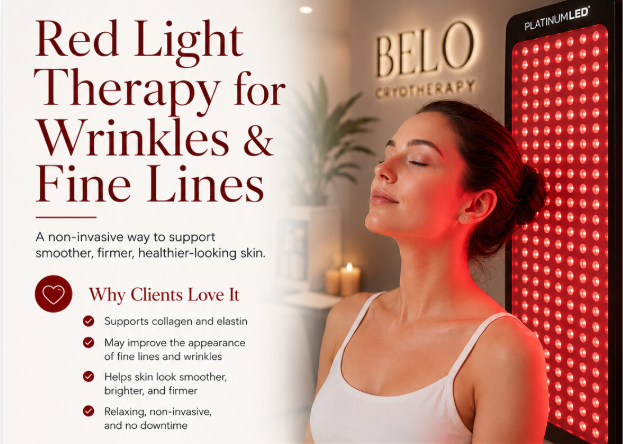
Red Light Therapy for Wrinkles and Fine Lines: What Actually Happens to Your Skin?
You notice it in a photo first.
A fine line around your eyes that wasn’t as noticeable before. A deeper crease across your forehead. Skin that doesn’t seem quite as firm or bright as it used to.
Then you start seeing red light therapy everywhere.
Celebrities use it. Spas offer it. At-home masks are all over social media. But the question most people really want answered is simple:
Does red light therapy for wrinkles and fine lines actually do anything?
The answer is more interesting than a simple yes or no.
Red light therapy isn’t Botox. It doesn’t fill a wrinkle, freeze a facial muscle, or dramatically resurface your skin overnight. Instead, it works at the cellular level, supporting processes involved in healthier-looking skin.
And that may be exactly why so many people are adding it to their anti-aging routines.
At Bel0 Cryotherapy in East Hanover, NJ, we offer professional red and near-infrared light therapy for clients who want a comfortable, non-invasive way to support smoother, firmer and healthier-looking skin.
Why Is Everyone Talking About Red Light Therapy for Skin?
Red light therapy is also known as photobiomodulation, or PBM.
That sounds complicated, but the basic idea is surprisingly simple.
Specific wavelengths of red and near-infrared light are delivered to the skin, where they interact with cells and may influence cellular energy production and signaling.
According to PlatinumLED’s guide to red light therapy for wrinkles and fine lines, red wavelengths around 630 to 660 nm are particularly relevant to more superficial skin processes, while near-infrared wavelengths around 810 to 850 nm penetrate more deeply.
Why does that matter?
Because younger-looking skin isn’t just about what happens on the surface.
Collagen, elastin, fibroblasts, cellular energy and the extracellular matrix all play roles in how firm, smooth and resilient your skin appears.
Research examining photobiomodulation in dermatology has explored how these wavelengths interact with cellular photoreceptors and biological processes within the skin. You can read a detailed review of photobiomodulation in dermatology here.
The Collagen Connection Most People Don’t Understand
You’ve probably heard the word collagen hundreds of times.
It’s in creams. Supplements. Powders. Beauty ads.
But red light doesn’t simply shine on your skin and magically “add collagen.”
One of the more interesting parts of red light therapy involves cells called fibroblasts.
Fibroblasts help produce collagen, elastin and other components that contribute to the structure of your skin. Research into photobiomodulation suggests that light exposure may influence fibroblast activity and cellular signaling involved in tissue remodeling.
You can see research discussing photobiomodulation and fibroblast activity here.
This is one reason red light therapy for wrinkles and fine lines shouldn’t be thought of as a quick cosmetic trick.
It’s about supporting processes that happen gradually.
So When Will You Actually See a Difference?
This is where expectations matter.
If someone tells you one red light therapy session is going to erase your wrinkles, be skeptical.
Some people may notice their skin looks brighter, fresher or more radiant fairly quickly.
Changes involving firmness, texture and the softened appearance of fine lines typically take longer.
A 2023 study examining photobiomodulation and facial skin aging reported gradual improvements in measures including skin smoothness, elasticity and overall appearance following repeated treatments.
PlatinumLED also emphasizes that visible improvements are cumulative.
In other words, consistency matters.
Their wrinkle-focused guidance notes that more noticeable changes may develop over approximately 4 to 12 weeks of consistent use.
That makes red light therapy much more similar to exercise than to getting a filler.
One workout doesn’t transform your body.
One healthy meal doesn’t transform your health.
And one red light session isn’t likely to transform your skin.
But repeated exposure over time may support changes that become increasingly noticeable.
What Red Light Therapy Can — and Cannot — Do for Wrinkles
This is the part that often gets left out of beauty advertising.
Red light therapy for wrinkles and fine lines may help support:
- Smoother-looking skin
- Firmer-looking skin
- Improved overall skin appearance
- More even-looking texture
- Skin radiance and glow
- Collagen-related processes
- Elastin-related processes
- A softer appearance of some fine lines
But it isn’t the same treatment as Botox, fillers, microneedling, laser resurfacing or cosmetic surgery.
Those treatments work in completely different ways.
Someone wanting a dramatic structural change to a deep wrinkle may need a different cosmetic approach.
Someone looking for a comfortable, non-invasive treatment they can incorporate into an ongoing skincare and wellness routine may find red light therapy much more appealing.
There are no injections, no incisions and no traditional recovery period.
Are Longer Red Light Sessions Better?
Not necessarily.
This is one of the biggest misconceptions surrounding red light therapy.
People naturally assume that if 10 minutes is beneficial, 30 minutes must be three times better.
Photobiomodulation doesn’t necessarily work that way.
PlatinumLED specifically warns against the “more is better” mentality. Effective use is based on appropriate exposure, distance and consistency—not simply sitting in front of the strongest light for as long as possible.
For wrinkle-focused use, their general guidance emphasizes:
Clean skin. Appropriate distance. Reasonable session length. Consistency over time.
Heavy makeup or skincare products can potentially interfere with how light reaches the skin, which is why clean skin is generally preferred.
PlatinumLED also advises avoiding direct eye exposure and using additional caution in certain medical situations. Their red light therapy safety information provides additional details.
Red Light Therapy for Wrinkles and Fine Lines in East Hanover, NJ
At Bel0 Cryotherapy, we make red light therapy simple.
You come in, get comfortable and relax while our professional PlatinumLED red and near-infrared light system delivers the session.
That’s it.
No needles.
No freezing.
No injections.
No complicated recovery instructions.
For many people, the relaxing nature of the treatment is one of the reasons it becomes something they actually look forward to.
Our red light therapy may be especially appealing if you’re concerned about areas such as:
Crow’s feet around the eyes, forehead lines, fine lines around the mouth, dull-looking skin, uneven texture, or a gradual loss of firmness.
And because red light therapy for wrinkles and fine lines works best as part of a bigger picture, we also encourage clients to think about their overall skincare habits.
Daily sunscreen, hydration, adequate sleep, nutrition and a consistent skincare routine still matter.
Red light therapy isn’t meant to replace those things.
It’s another tool.
The Bottom Line: Is It Worth Trying?
If you’re looking for a treatment that completely removes wrinkles overnight, red light therapy probably isn’t what you’re looking for.
But if you want a non-invasive, comfortable way to support healthier-looking skin over time, the research around photobiomodulation makes it an interesting option.
The most important word is consistency.
Give your skin time.
Pay attention to how it looks and feels.
Take photos so you can compare changes instead of relying on what you remember seeing in the mirror.
And approach it as part of a long-term skincare routine rather than a one-session miracle.
If you’ve been wondering whether red light therapy for wrinkles and fine lines belongs in your anti-aging routine, come experience it for yourself at Bel0 Cryotherapy in East Hanover, NJ.
We serve clients from East Hanover, Livingston, Florham Park, Hanover, Parsippany, Morris Plains, Madison, Morristown, Roseland and surrounding North Jersey communities.
Book your red light therapy session at Bel0 Cryotherapy and see why this simple-looking light technology has become one of the most talked-about additions to modern skincare.
Results vary. Red light therapy is not intended to diagnose, treat, cure or prevent disease. People with photosensitivity, implanted devices, pregnancy, seizure disorders, medications that increase light sensitivity or other medical concerns should speak with an appropriate healthcare professional before treatment.